02. Politics, governance and society
Summary
Every serious attempt to found a libertarian polity in the last 55 years has failed for political or social reasons long before it failed for engineering ones. Minerva was annexed by Tonga within five months. Liberland's settlement was demolished by Croatian police. Ocean Builders' first seastead was towed away by the Thai navy, and its occupants were threatened with the death penalty. The French Polynesia deal was killed by a local election campaign. Próspera, the most successful project of the lot, has about 100 physical residents and is now fighting a sovereign state in international arbitration after that state repealed the law it was built on. The projects that last (Tristan da Cunha, Twin Oaks, the kibbutzim for most of the twentieth century) have tight membership boundaries, high trust, cheap ways of resolving conflict, a clear economic base and a legitimate relationship with an outside state.
For 100 to 150 people the governance problem itself is tractable. It is about the size of a large strata scheme, a ship's company or a village. We recommend a hybrid:
- a short founding charter that every adult signs as a contract;
- strata-style property rights in the hull and modules;
- an all-resident assembly plus a small elected council;
- a professional, non-elected Master whose emergency powers are narrow, triggered by defined events and time-limited;
- mediation on board, with binding external arbitration seated in Singapore (SIAC) or London (LCIA);
- host-state criminal law and courts for anything violent, sexual or involving children.
The hard problems are elsewhere: winning and keeping a host state, avoiding the "billionaire escape pod" story, banking access, children and teenagers, medical evacuation, founder dynamics and money running out. Our verdict is Amber for a community inside a host nation's sheltered waters and Red for any plan that relies on high-seas sovereignty.
1. Intellectual lineage: what was promised and what was delivered
1.1 Seasteading
The Seasteading Institute (TSI) was announced on 15 April 2008 to "establish permanent, autonomous ocean communities to enable experimentation and innovation with diverse social, political, and legal systems", building on Patri Friedman and Wayne Gramlich's work13. Peter Thiel pledged US$500,000 in seed money2.
The core claim is Friedman's "dynamic geography": if buildings float, a household or neighbourhood can detach and leave a badly run jurisdiction, so "if the state tries to impose a sales tax on Monday, the capitol building may be all that's left of the city by Tuesday"4. Friedman and Taylor's academic version concedes that "mobility is surely limited far more by work and social obligations than by the physical costs of relocation"5. The ancestors are Tiebout (1956), in which residents "vote with their feet" between competing jurisdictions, under assumptions of full mobility and many communities6, and Hirschman (1970), who questions "the efficiency of the competitive mechanism, with its total reliance on exit" and gives loyalty the job of slowing exit so that voice can work7.
Seasteading is a bet on exit. A 150-person floating town will run on voice: a family whose house sits on a shared hull cannot sail away.
The political tone was set by Thiel's 2009 essay: "I no longer believe that freedom and democracy are compatible", with seasteading named as an escape from politics alongside cyberspace and space8. That sentence has followed seasteading into every hostile press cutting since. Joe Quirk and Patri Friedman's 2017 book Seasteading (Free Press) took a greener, humanitarian line and presented French Polynesia as the first host9.
1.2 Charter cities and network states
Paul Romer's charter cities proposed new cities with new rules on empty land in developing countries, under some outside supervision. In Honduras, Romer chaired a Transparency Commission whose appointment decree was never published. He resigned in 2012 after the government signed a zone agreement he was not allowed to see1011. Madagascar's earlier interest ended amid violent protest and the fall of President Ravalomanana12. The lesson that runs through this chapter is that handing foreign groups control of territory is politically radioactive in post-colonial states.
Balaji Srinivasan's The Network State (2022) reverses the order, "cloud first, land last": an aligned online community with a "recognized founder" crowdfunds scattered physical nodes and seeks recognition at the end13. It centres a founder (a governance risk, section 6) and treats territory as the last and hardest step.
1.3 Promised versus delivered
| Promise | Delivered (to Nov 2026) |
|---|---|
| Autonomous communities on the high seas | None. TSI moved to host-nation waters around 2013, then the French Polynesia MOU lapsed in 201816 |
| "Vote with your house" competition between floating jurisdictions | No multi-module floating polity exists. Friedman himself now says seasteading has made little progress, that "the ocean is just very difficult and very expensive", and that land-based zones are "much more tractable"14 |
| New governance experiments | Mostly on land: Próspera (Honduras), plus network-state pop-ups |
| Funding from tech wealth | Seed grants, then a failed token sale. The Blue Frontiers Varyon presale missed its threshold during the 2018 crypto crash and buyers were refunded17. Academic critics note that no major investor buy-in followed and that Thiel distanced himself15 |
The honest reading is that the idea has been an excellent generator of designs, conferences and media, and a poor generator of residents.
2. Case studies: what made them fail or succeed
2.1 Summary table
| Case | Type | Size | Outcome | Main cause |
|---|---|---|---|---|
| Próspera, Honduras (2020–) | Private charter zone | ~100 residents, 2,262 e-residents | Operating but legally contested | Host-state political reversal |
| Liberland (2015–) | Claimed terra nullius | Near zero on site | Settlement demolished 2023 | No host consent; neighbour controls access |
| Free State Project, NH (2001–) | Political migration | ~2,000 movers by 2016 | Partial political influence | Capture tactics provoked local backlash |
| Republic of Minerva (1972) | Artificial island | A handful | Annexed by Tonga | Regional states closed ranks |
| Blueseed (2011–13) | Offshore ship | 0 | Shelved | Could not raise capital |
| Ocean Builders, Thailand (2019) | Spar home in EEZ | 2 | Seized by navy | Declared independence from host law |
| Arcosanti, Arizona (1970–) | Founder-led arcology | <100 (planned 5,000) | Survives, much smaller than planned | Founder-centric, no economic base |
| Twin Oaks, Virginia (1967–) | Secular commune | ~100 | Durable for 59 years | Clear rules, labour system, screening |
| Kibbutzim (1910–) | Collective villages | Hundreds each | Thrived, then mostly privatised | High trust, then debt crisis and brain drain |
| Pitcairn | Tiny remote polity | ~40 | Systemic child abuse, then decline | No outside oversight, closed community |
| Tristan da Cunha | Tiny remote polity | ~230 | Durable | Communal land, clear economy, outside state support |
| St Kilda (to 1930) | Remote island | 36 at the end | Evacuated at own request | Young adults left, economy collapsed |
| Biosphere 2 (1991–93) | Sealed habitat | 8 | Mission completed, crew split | Confinement plus outside power struggle |
2.2 Libertarian and new-polity projects
Próspera is the closest analogue to this project: a private charter, privately supplied rules and its own arbitration centre. Neighbouring Crawfish Rock objected early that few construction jobs went to villagers, that armed guards questioned residents, and that plans appeared to absorb village land18. The promoter held four of nine council seats on seven-year terms19. Honduras repealed the ZEDE law in 2022, and in 2024 its Supreme Court declared the framework unconstitutional from the outset20. The investors' CAFTA-DR claim at ICSID is pending21; Bloomberg put the original US$10.8 billion figure at roughly a third of Honduran GDP22, and it was later cut to US$1.63 billion20. In 2026 Próspera reported 2,262 e-residents and about 100 physical residents23. Lessons: a zone created by one government can be destroyed by the next; suing a poor country for a large share of its GDP may win in law but loses in politics; and low local benefit plus private security plus opaque land plans is a reliably bad combination.
Liberland (2015, 7 km² of Danube floodplain24) has gathered huge numbers of online sign-ups, half a million by one BBC count26, but Croatian police control access and escorted demolition of its settlement in 202325. Lesson: online enthusiasm does not become physical presence, and whoever controls the access route controls the polity. For a seastead, that is the port, the fuel dock and the airport.
The Free State Project hit its 20,000-signature trigger in 2016, with about 2,000 already moved to New Hampshire27. In Croydon, Free Staters used a town meeting attended by 34 voters to halve the school budget by 20 to 14; residents then turned out in historic numbers and reversed it by 377 to 228. In Grafton, a "Free Town" effort cut budgets and services, and the town became known for decay and bear attacks29. Lessons: low-turnout direct democracy can be captured, capture produces fierce backlash, and even libertarians expect working schools, roads and wildlife control.
Minerva (1972): Michael Oliver's group raised a reef with Australian sand and declared a republic; Tonga proclaimed the reefs Tongan within months, sent troops, and the project collapsed amid infighting3031. Lesson: neighbouring states act together against sovereignty claims near their waters.
Blueseed (2011–13) planned a ship 12 nautical miles off California for about 1,000 foreign entrepreneurs without US work visas32, and stalled for lack of funding33. Lesson: even a sharp business case could not finance a vessel; a residential seastead's case is weaker.
Ocean Builders (2019) anchored a spar home 12 to 14 nautical miles off Phuket, and its occupants declared themselves independent of any state's law. Thailand said it was in its EEZ, charged them with violating sovereignty (potentially a capital offence) and towed the structure away as evidence3435. The firm's Panama SeaPod prototype later tilted onto a dock at its 2022 launch in front of Panama's president36. Lesson: never announce independence from a host whose navy is nearby.
2.3 Intentional communities
Arcosanti was designed for 5,000 but "has never been occupied by more than 100"37; after the founder's death his daughter alleged abuse that his "inner circle knew about"38. Lesson: a founder-centred community inherits both the vision and the shadow, and safeguarding cannot rely on the founder's circle.
Twin Oaks (1967, about 85 adults and 15 children) has outlasted almost every secular commune of its generation with mundane tools: a written labour-credit system, rotating planners with a right of appeal, a visitor period followed by an absence and a membership decision, and written procedures for conflict and for behaviour with "an intolerable impact"39. Lesson: boring, written process beats charisma.
Kibbutzim handled free-riding, adverse selection and brain drain through screening, probation and communal property that made exit costly40. After the 1985 debt crisis and the high-tech boom most moved to differential pay, and by 2010 only about a quarter stayed fully egalitarian41. Lesson: founding idealism decays; institutions must work for a second generation that did not choose to be there.
Sosis found 19th-century religious communes outlived secular ones at every stage, which he attributes to costly commitment signals54; Kanter links longevity to "commitment mechanisms"55. A libertarian community has thin shared ritual by design, so it must lean harder on contracts, clear economic interest and good process.
2.4 Tiny remote communities
Pitcairn (UK territory, 47 people at the time) is the most important negative case. In 2004, seven men, about half the island's adult men, were tried on 55 sexual-offence charges reaching back decades; six were convicted. Defendants argued that underage sex was traditional and that British law did not apply, and some island women backed the tradition claim42. By 2024 about 40 people remained, mostly elderly, and the school had closed because the last three children were at boarding school in New Zealand43. Lessons: in a tiny closed polity the norm-enforcers may be the offenders, victims cannot leave or complain to anyone unrelated, and child protection needs an outside channel the community cannot capture.
Tristan da Cunha (about 230 people) is the positive counterpart. Land is communal, livestock is capped "to prevent better off families accumulating wealth", outsiders may not buy land or settle, and income comes from a regulated lobster fishery, stamps and tourism44. Evacuated to England after the 1961 eruption, islanders voted 148 to 5 to return45. Serious medical cases go to Cape Town, and it "can be up to 2 months before a ship is available"46. Lessons: a clear economic base, shared identity, strict entry rules and a supportive outside state (a UK Administrator alongside an elected Island Council) produce durability, at the price of very low openness.
St Kilda was evacuated in 1930 at its own request. The petition says several of the men who "tend the sheep, do the weaving and look after the general welfare of the widows" were leaving and that the island "has not been self supporting"47; decline accelerated as imports replaced self-sufficiency and wartime naval supply ended48. Lesson: lose the working-age adults and the place fails within a generation.
2.5 Confinement and isolation research
Biosphere 2's eight crew (1991–93) split into two hostile groups of four, and the split was made "much worse" by a power struggle among owners and advisers outside the dome4950. Antarctic research describes a "winter-over syndrome" of poor sleep, impaired cognition, low mood and interpersonal conflict; about 5% meet psychiatric criteria, but many report growth, and screening and support help51. A 2017 meta-analysis did not confirm the popular "third-quarter" slump52. The 520-day Mars-500 simulation recorded creeping inactivity and sleep–wake disruption in most crew53. A sheltered-water seastead with a ferry to town is far less confining, but the lessons transfer: daylight, exercise, routine, privacy and outside contact protect mental health, and conflict among external stakeholders propagates inward.
3. Governance design for 100 to 150 people
3.1 Scale
Dunbar's 1992 extrapolation from primate brains gave a "natural" human group of about 15056; a 2021 re-analysis found the method yields anything from about 4 to 520, so "specifying any one number is futile"57. Use it loosely. At 100 to 150 people everyone knows everyone, gossip is an effective sanction and informal norms do much of the work, but recusal is nearly impossible. At Phase 2 (about 300 plus staff) informal control weakens, so write the charter for 300 from day one.
Ostrom's design principles for long-lived commons map almost exactly onto a shared hull: clear boundaries, locally fitted rules, collective choice, monitoring, graduated sanctions, cheap conflict resolution, recognition by the outer authority, and nested tiers58. Seasteaders tend to ignore the seventh: outside authorities must not challenge the right to organise.
3.2 Options compared
| Model | Strengths | Weaknesses at this scale | Verdict |
|---|---|---|---|
| Shareholder corporation / HOA (promoter-controlled) | Fast decisions, investor-friendly, familiar to banks | Residents become customers. Próspera-style promoter seats invite "company town" framing19 | Useful as the asset layer only |
| Direct-democracy town meeting | Legitimacy, cheap, suits about 100 adults | Low-turnout capture (Croydon)28, slow, bad in emergencies | Keep for charter and budget, with quorum rules |
| Constitutional republic (elected council, rights, courts) | Proven checks and balances, legible to host states | Heavy for 150 people. Courts are not viable locally | Lightweight version is the core |
| Private / polycentric law with arbitration | Matches libertarian ethos, enforceable worldwide via the New York Convention (172 parties)63 | Arbitration cannot handle crime, child protection or status matters. Cost can exclude poorer residents | Civil disputes only |
| DAO / on-chain governance | Transparent voting records | The DAO hack (2016) showed no capacity for emergency response59. Across about 30,000 DAOs, participation is low and power concentrates as they grow60. Regulators and banks are wary | Optional tool for recording votes, not the constitution |
3.3 Recommended hybrid
Layer 1: legal wrapper (host-state). A special zone or concession agreement with the host state (design-basis archetype 1). Criminal law, child protection, immigration, AML/CFT and maritime safety stay with the host. The community governs civil, property and municipal matters by contract. This is less romantic than sovereignty and far more survivable.
Layer 2: asset layer (strata/condominium analogue). A Platform Owners' Corporation owns the hull, moorings, utilities and common areas. Each household owns a lot (house module plus garden) with a unit entitlement that sets both levies and votes on asset questions. This mirrors strata law, for example in New South Wales, where owners automatically form the owners' corporation, levies are proportional to unit entitlement, and a 10-year capital works plan is required61. NSW by-laws may not be "harsh, unconscionable or oppressive", may not ban children, and may not stop an owner from selling. Those are good minority-protection defaults to copy.
Layer 3: civic layer (charter). - An Assembly of all adult residents. It votes on the charter, the annual budget and removals. Quorum is 60% of adults, which closes the Croydon loophole. - A Council of five, elected by single transferable vote for staggered two-year terms, limited to three terms. It runs day-to-day policy and appoints officers. - An external Ombudsperson and Safeguarding Officer, appointed jointly with the host authority or an independent NGO and paid from levies. They can take complaints from any resident, including children and staff. - A Master, a professional marine officer who is hired rather than elected. The Master holds safety authority (section 3.6).
Layer 4: disputes. 1. A neighbour-mediation panel of trained residents. 2. Binding arbitration under SIAC Rules 2025. The Streamlined Procedure applies automatically to claims up to S$1 million: one arbitrator, normally on the documents, award within three months, capped fees64. London (LCIA) is the obvious alternative for an Atlantic or European host. 3. Host-state courts for anything criminal, and for judicial review of the arbitration.
Próspera's choice of a captive in-house arbitration centre65 is cheaper but less credible. An external seat signals to banks, host states and residents that disputes will not be settled by the founders' friends.
3.4 Entry, exit and removal
- Entry: application, visit, 6 to 12 months' probationary residence (as Twin Oaks and the kibbutzim do3940), then an Assembly vote. Criminal-record and child-safeguarding checks apply to every adult, staff included, along with host-state KYC for banking.
- Exit: an entrenched right to leave at any time. A lot may be sold to any buyer who passes entry vetting. The Corporation has a right of first refusal at an independently assessed value. A buy-back reserve funded from levies stops households being trapped by a thin resale market. This is the floating version of Hirschman's insight: exit has to be real, but not so easy that the community bleeds.
- Removal of a bad actor: graduated sanctions, in the order warning, fine, suspension of amenities, then removal58. Removal requires a written finding of serious or persistent breach, a hearing, a two-thirds Assembly vote, and a right to arbitral review. The person's property is then sold at fair value; it is never confiscated. New York's courts have upheld exactly this model for cooperatives that terminate an "objectionable" shareholder's lease under a pre-agreed contractual clause, provided the board acts in good faith and within its authority62. Anything that may be a crime goes to the host police, not to the Assembly.
3.5 Funding public goods
There is no income tax. Revenue comes from:
- strata levies by unit entitlement, split into an operating fund and a capital works / sinking fund covering hull maintenance over the 50-year design life;
- metered user charges for power, water and berths;
- commercial rents from the café, guest rooms and marina;
- a visitor fee;
- an emergency and evacuation reserve held off-platform with a regulated custodian.
Levy arrears accrue interest and ultimately trigger forced sale, as in strata schemes. Operating costs belong to the economics chapter, but staff (section 8) will be the largest recurring item.
3.6 Emergency powers: a ship needs a captain
International maritime law already resolves the tension. SOLAS regulation V/34-1 says no owner, charterer "or any other person" may prevent the master from taking any decision that "in the master's professional judgement, is necessary for safety of life at sea and protection of the marine environment"66. We recommend copying both the principle and its limits:
- Scope: safety of life, the hull's integrity, pollution prevention and evacuation. Not property, speech, membership, budgets or the charter.
- Trigger: objective events (a named storm warning, hull breach, fire, medical mass-casualty) or a Council resolution.
- Duration: 72 hours, renewable by Council for 72 hours at a time, with automatic expiry. This follows the Venice Commission's tests of necessity, proportionality and temporariness, and its view that emergencies must not change the constitution67.
- Accountability: a written log, and an after-action review to the Assembly within 30 days. The Master can be dismissed by the Council for cause, but not during the emergency.
Libertarians can accept this because it is contractual and known in advance, exactly as passengers accept a master's authority when they board a ship.
3.7 Amendment and minority protection
- Ordinary charter amendments need a two-thirds Assembly vote and 75% of lots, with a 90-day cooling-off period.
- Entrenched articles cannot be amended while anyone who relied on them is resident. These are the right of exit, non-confiscation, children's rights, non-discrimination, the external ombudsperson and arbitration.
- Founder sunset: any special founder or investor seats lapse automatically at the earlier of five years or 60% occupancy. Próspera's seven-year, unlimited-term promoter seats19 are what to avoid.
3.8 Children's rights and education
Children are about a third of the launch population and did not consent to the charter. It should guarantee (a) education to recognised qualifications (host-state or international curriculum) with external inspection; (b) host-state child-protection law, the external safeguarding officer and mandatory reporting by every adult; and (c) a funded right to off-platform secondary or tertiary study and an unconditional right to leave at 18 with an exit grant. Pitcairn shows what happens without (b)4243.
4. Social sustainability
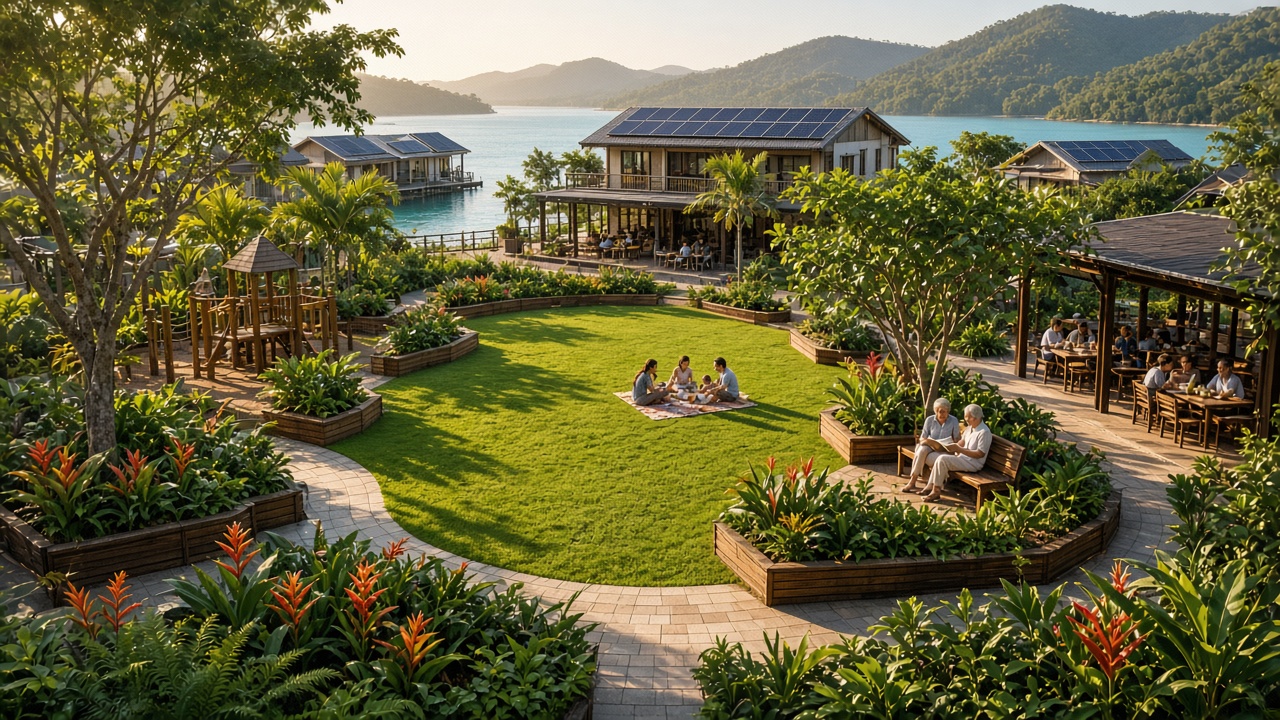 AI-generated impression, not a design drawing. The central park, playground and community pavilion. Public open space is about 50 m² per resident in the reference design and 27.5 m² in Village 40.
4.1 Demographics and the teenage problem
Tristan educates children to 16, then they board in the UK or South Africa if they want more69. Pitcairn's children usually leave at 13, and many do not return70. About 35 children aged 0 to 17 means two or three teenagers finishing each year, each one a family deciding whether to follow. Our judgement: plan for families leaving when their eldest reaches 14 to 16 and recruit to offset it. Practical responses are a site within a daily ferry ride of a good secondary school (archetype 1); three to four teachers; blended online secondary courses (contested, as the Croydon micro-school plan showed28); and a deliberate age mix, because the second generation decides survival4148.
4.2 Healthcare
A town of 100 to 150 people with 20 visitors is comparable to a small cruise ship. The cruise industry's ACEP guidelines, which CLIA members follow for ships carrying 100 or more people, require at least one physician and one other clinician available 24 hours a day at sea. They also call for paediatric and trauma life-support training, an emergency and stabilisation room, an intensive care bed and an isolation room68. Covering that around the clock needs three to four clinicians on rotation. That is more than a third of the design basis's staff allowance on its own.
The decisive variable is evacuation time:
| Setting | Indicative time to hospital (judgement) | Implication |
|---|---|---|
| Archetype 1, sheltered host waters, port and airport nearby | 30 min to 2 h by boat or helicopter | GP-plus clinic is acceptable |
| Archetype 2, 12 to 200 nm offshore | 2 to 8 h, weather-dependent | Need a stabilisation capability plus a helideck |
| Archetype 3, high seas | Days. Tristan waits up to two months for a ship46 | Not acceptable for families with infants, pregnancies or elderly members |
Births should be planned ashore. Dialysis, chemotherapy and elective surgery mean temporary relocation.
4.3 Isolation, "island fever" and mental health
"Island fever" is a folk term, but the underlying risks (poor sleep, inactivity, low mood, conflict) are well documented in isolated groups5153. Mitigations from polar programmes: screening and a pre-move trial stay, confidential off-platform counselling, private space in every home, funded shore leave (at least one trip a month per resident), structured roles and routine, and rotation for staff. Some residents will simply leave; that is the system working.
4.4 Conflict resolution
Disputes over noise, children, dogs, boats, money and romance will dominate, and there is nowhere to cool off. Twin Oaks-style written procedures, a trained mediation rota and a clear escalation path39 are worth more than any constitutional clause. Biosphere 2 adds: keep investor and founder fights out of daily life and give residents honest information49.
4.5 Gender, family and ageing
Libertarian projects skew male; the Grafton newcomers were "overwhelmingly men"29, and Twin Oaks keeps a dedicated letter for prospective women members39. For families the risk is the trailing partner, isolated with small children while the enthusiast thrives. Require both adults to complete the probationary stay, and design childcare and work space for the less enthusiastic partner. Domestic violence needs a host-police pathway and an off-platform refuge agreement from day one. Ageing founders will need step-free access, home care and eventually a move ashore; recruit retirees with eyes open.
4.6 When founders disagree or money runs out
Minerva's founder sacked its provisional president as the project collapsed31; Biosphere 2's owners fought while the crew were sealed inside49. Plan for both:
- Founder disputes: founders hold no governance role beyond ordinary votes after the sunset date. Investor rights sit in the asset layer, not the civic layer. Disputes among investors go to arbitration, not to the Assembly.
- Insolvency: the sinking fund and evacuation reserve are ring-fenced. Lenders and the host get step-in rights to keep life-safety systems running. A pre-agreed decommissioning plan covers towing, sale or scrapping, so that "money ran out" means an orderly sale rather than a St Kilda-style petition47.
5. Geopolitics and reputation
5.1 How host states and great powers will see it
To a host state, a self-governing enclave in its waters is a sovereignty question first and an investment second. Thailand's response to two people in a cabin shows the reflex34. Great powers will mostly ignore a 5-acre village. They will care if it touches sanctions (ship-to-ship transfers, opaque ownership, "flag hopping"), crypto flows, or their own citizens' tax79. The EU's tax blacklist, revised twice a year, currently names eight jurisdictions, including several small Pacific and Caribbean islands78. A host on, or near, that list makes banking and EU relations harder.
5.2 Case: French Polynesia, 2017 to 2018
The agreement was announced at Christmas 2016 and signed in January 2017 as a non-binding memorandum. Local voices immediately worried that "rich Americans" wanted "to dodge taxes", and critics called it "tech colonialism"71. Once the Atimaono lagoon at Mataiea was named as the site, about 80 residents formed the association No to'u Here ia Mataiea, complaining of a lack of information, and opposition candidates made it an issue in the 2018 territorial election campaign72. The government then declared the memorandum void, "not a legal document" that had expired at the end of 20177374. TSI blames a "small minority" spreading "misinformation" plus a crypto crash16. Lessons: the site was named before local consultation; the deal rested on a non-binding paper signed by one administration in an election year; the visible benefits (tax-free zone, technology) went to outsiders; fishing grounds and a culturally significant lagoon were at stake; and financing depended on a token sale that failed17. Every one of these is avoidable.
5.3 The "billionaire escape pod" frame
Douglas Rushkoff's widely read 2022 account of super-rich "preppers" puts seasteading in the same breath as bunkers in New Zealand and plans for Mars75. Academic critics describe seasteads as "the promise to investors one of great luxury", with "no actual prospects for building affordable housing"15. This chapter's judgement is that the frame cannot be argued away, only out-competed with facts. Useful facts would include local equity, local jobs, open public space, published accounts, a scientific programme and residents who are visibly not billionaires.
5.4 Banking and FATF
The FATF says banks should manage risk case by case rather than "wholesale cutting loose of entire classes of customer"76. In practice, de-risking is real. The Pacific islands have lost correspondent-banking relationships for two decades, which raises costs and pushes flows into informal channels77. A new micro-jurisdiction associated with crypto and tax avoidance is a textbook de-risking candidate.
Mitigations: bank through a regulated host-state institution with full KYC; publish the Corporation's beneficial ownership; adopt a written AML/CFT policy to host and FATF standards; issue no community token; appoint a compliance officer; and make clear that residents remain responsible for their home-country tax, so the community is visibly not a tax shelter.
5.5 How to win a host state over
| Offer | Why it works |
|---|---|
| Local equity stake or golden share for the host or municipality | Turns a "foreign enclave" into a joint venture. The Maldives Floating City is a government joint venture aimed at housing locals8081 |
| Local hiring and procurement targets, published annually | Answers the Crawfish Rock complaint about jobs18 |
| Pay host taxes on commercial activity and a concession fee | Removes the "tax haven" story |
| Public access to the park, marina and café | Converts the platform from a gated compound into a destination |
| Climate-adaptation demonstrator with a university partner, with open data | Gives ministers a reason to defend it. Note that Oceanix Busan stalled for lack of US$600 million in financing, so bring the money first82 |
| Consultation before site selection, with fishers, landowners and customary authorities | The French Polynesia failure in one line |
| Binding legal instrument (statute-backed concession) with cross-party support, not an MOU | An MOU died with one election73; even Próspera's constitutional basis proved reversible20, so political breadth matters as much as legal form |
6. Who would actually move?
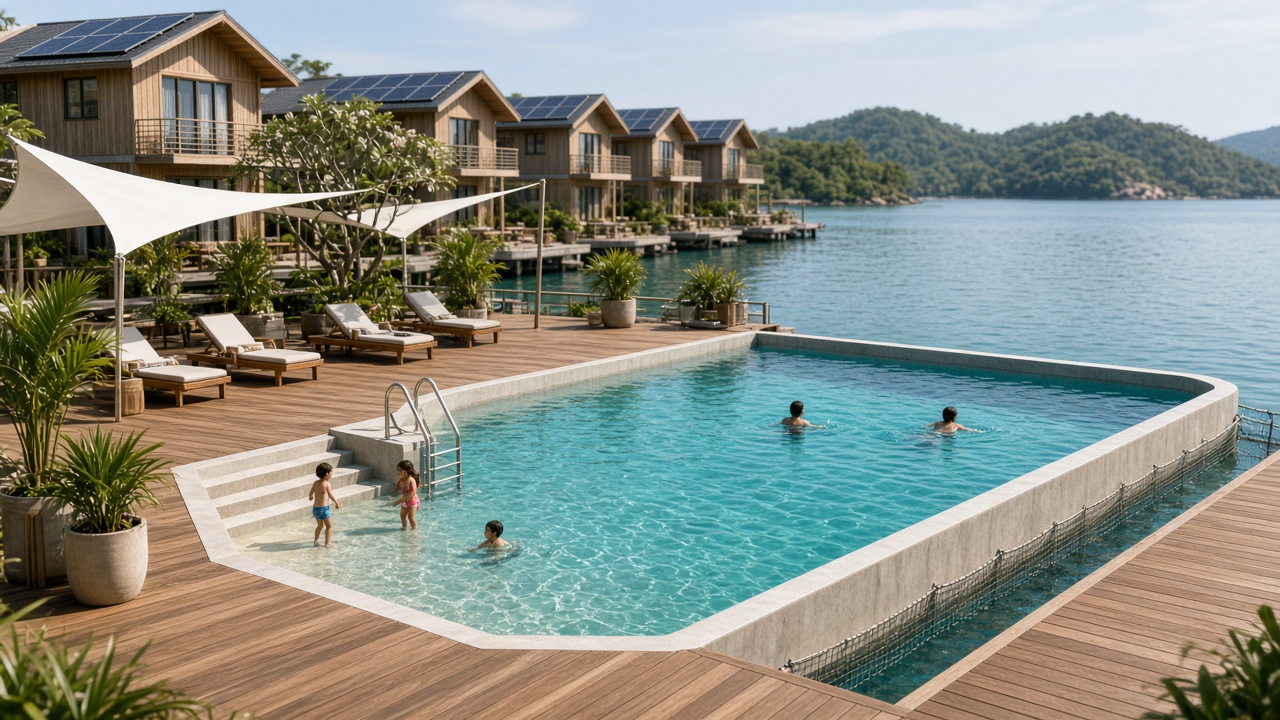 AI-generated impression, not a design drawing. A netted seawater swimming lagoon set into the platform edge, with timber decking and a shallow children's area.
| Segment | Likely share (judgement) | Needs | Risk |
|---|---|---|---|
| Remote professionals and founders (tech, finance, creative) | 40–50% | Fast, redundant internet, co-working, travel links | Footloose. Leave when the novelty fades |
| Early retirees and "semi-retirees" | 15–25% | Healthcare, accessibility | Medical evacuation burden |
| Entrepreneurs running on-platform businesses (hospitality, marina, aquaculture, tours) | 10–15% | Customers, permits | Small market |
| Marine scientists and conservation staff (institutional partner) | 5–10% | Lab space, grants | Turnover with grant cycles |
| Crypto-wealthy idealists | 5–15% | Ideological fit | Concentration of wealth and influence, reputational risk |
| Resident staff (marine ops, clinic, school) | 15–25 people | Pay, rights, housing | Two-class society if staff lack a vote |
Remote work is now mainstream. MBO Partners counts 20.3 million US workers self-describing as digital nomads in 202683. The pool of people who could live on a seastead is therefore large. The pool who will commit a family and a house to it is small. Patri Friedman himself warns that pop-up gatherings "select for the rootless", people who "are generally not the ones who will settle permanently, raise families, and build the long-term fabric of a community"14. Recruit for staying power, not enthusiasm.
Cults of personality. The network-state model places a "recognized founder" at the centre13. Arcosanti and Pitcairn show what happens when no one can challenge the people at the centre3842. Warning signs: one person controlling admissions, money and communications; critics recast as disloyal; pressure to sell land-based homes; secrecy about finances. The founder sunset, external ombudsperson, external arbitration and published accounts are the antidote.
7. Draft outline of a founding charter
- Purpose and nature. A voluntary community formed by contract. It operates under the [host] Concession Agreement and does not claim sovereignty.
- Relationship with the host state. Host criminal, immigration, child-protection, AML/CFT and maritime-safety law apply. Liaison procedures.
- Rights of residents (entrenched). Life, bodily integrity, speech, association, privacy, property, due process, non-discrimination, and the right to leave at any time.
- Children (entrenched). Recognised education, safeguarding with mandatory reporting, an external safeguarding officer, and the right to leave at 18 with an exit grant.
- Membership. Admission, probation and vetting. Categories: owner, tenant, staff, visitor. Political rights of staff after 12 months.
- Property. Lots and unit entitlements, common property, rules on alteration, sale and right of first refusal, and non-confiscation (entrenched).
- The Assembly. All adults. Quorum 60%. Powers over the charter, budget, removals and by-laws.
- The Council. Five members, STV, staggered two-year terms, three-term limit. Executive and appointment powers.
- Officers. Master, Treasurer, Clinician-in-charge, Head Teacher, Compliance Officer. How they are appointed and dismissed.
- Emergency powers. The Master's safety authority. Triggers, 72-hour limit, renewal, log and review.
- Finance. Levies, user charges, sinking fund, evacuation reserve, external audit and published accounts.
- Conduct and sanctions. By-laws, graduated sanctions, removal procedure, and forced sale at fair value.
- Disputes. Mediation, then SIAC (or LCIA) arbitration, then host courts for crimes and review.
- Ombudsperson. An independent external appointment with powers to investigate and publish.
- Founders and investors. Rights confined to the asset layer. All special seats sunset at five years or 60% occupancy.
- Amendment. Two-thirds of the Assembly plus 75% of lots, a 90-day cooling-off, and entrenched articles listed.
- Dissolution and decommissioning. Ring-fenced reserves, step-in rights, and a plan for the hull.
8. Comments on the design basis
- "Country" and sovereignty. For politics and governance, only archetype 1 (host-nation sheltered waters under a binding concession) is viable for a family community. Archetypes 2 and 3 should be treated as later experiments, not launch options. Every case that asserted independence from a nearby state (Minerva, Liberland, Ocean Builders) was ended by that state.
- Resident staff of 10 to 15 is too low. A 24/7 clinic needs three to four clinicians68, the school three to four teachers, round-the-clock marine watch and engineering five to eight, plus administration and compliance. Plan for 18 to 25. The charter must also decide whether staff vote. A disenfranchised service class is both a moral and a reputational problem.
- About 35 children at launch is the hardest possible demographic (section 4.1). Consider launching with a mix weighted towards couples without children and families with under-11s, plus a secondary-education plan agreed before anyone moves.
- Phase 2 (about 300 plus 30 staff) is well beyond village scale. The charter and staffing should be designed for it from the start.
- Communal space. The 1,500 m² for the school, clinic, town hall, café, workshop and guest rooms is tight once the clinic meets cruise-style guidelines. Add room for a counselling and quiet space and for an emergency refuge.
Verdict: AMBER (feasible with significant caveats)
Feasible: governing 100 to 150 people on a shared hull, using strata-style property, a contractual charter, an elected council, a narrowly empowered Master and external arbitration. Every component has working precedents.
Not feasible (Red): any plan that depends on recognised sovereignty or on high-seas autonomy for families with children.
Top risks 1. Host-state reversal. An election or court ruling removes the legal basis (Próspera, French Polynesia). Mitigate: a binding concession with cross-party support, local equity, local jobs and host taxes. 2. Reputational framing ("billionaire escape pod", tax haven, crypto), which drives banking de-risking and political hostility. Mitigate: transparency, no token, regulated banking, public access and a research partner. 3. Demographic attrition. Teenagers and their families leave, and working-age adults are lost (St Kilda, Pitcairn). Mitigate: a site near schools, an age mix and active recruitment. 4. Safeguarding failure in a closed community (Pitcairn, Arcosanti). Mitigate: host law, external safeguarding officer and ombudsperson, and vetting of all adults. 5. Founder and investor conflict, or insolvency, spilling into daily life (Biosphere 2, Minerva). Mitigate: a founder sunset, separating the asset layer from the civic layer, ring-fenced reserves and a decommissioning plan.
References
-
The Seasteading Institute, "Introducing The Seasteading Institute" (press release), 15 April 2008. https://www.seasteading.org/introducing-the-seasteading-institute/ (accessed Nov 2026). ↩
-
Wired, "Peter Thiel Makes Down Payment on Libertarian Ocean Colonies", May 2008. https://www.wired.com/2008/05/peter-thiel-makes-down-payment-on-libertarian-ocean-colonies/ (accessed Nov 2026). ↩
-
The Seasteading Institute, "The History of TSI". https://www.seasteading.org/history/ (accessed Nov 2026). ↩
-
Patri Friedman, "Dynamic Geography: A Blueprint for Efficient Government", 2002. https://patrifriedman.com/old_writing/dynamic_geography.html (accessed Nov 2026). ↩
-
Patri Friedman and Brad Taylor, "Seasteading: Competitive Governments on the Ocean", Kyklos 65(2), 2012 (author copy). https://www.seasteading.org/wp-content/uploads/2015/12/Friedman-Taylor-2012-Seasteading-Competitive-Governments-on-the-Ocean.pdf (accessed Nov 2026). ↩
-
Charles M. Tiebout, "A Pure Theory of Local Expenditures", Journal of Political Economy 64(5), 1956, pp. 416–424. https://www.journals.uchicago.edu/doi/10.1086/257839 (accessed Nov 2026). ↩
-
Albert O. Hirschman, Exit, Voice, and Loyalty: Responses to Decline in Firms, Organizations, and States, Harvard University Press, 1970. https://www.hup.harvard.edu/books/9780674276604 (accessed Nov 2026). ↩
-
Peter Thiel, "The Education of a Libertarian", Cato Unbound, 13 April 2009. https://www.cato-unbound.org/2009/04/13/peter-thiel/education-libertarian (accessed Nov 2026). ↩
-
Joe Quirk with Patri Friedman, Seasteading: How Floating Nations Will Restore the Environment, Enrich the Poor, Cure the Sick, and Liberate Humanity from Politicians, Free Press (Simon & Schuster), 2017. https://www.simonandschuster.com/books/Seasteading/Joe-Quirk/9781451699272 (accessed Nov 2026). ↩
-
Paul Romer, "Honduras update" (Transparency Commission statement), 2012. https://paulromer.net/honduras-update/ (accessed Nov 2026). ↩
-
The Guardian, "Plans for Honduras start-up city hit by transparency concerns", 8 September 2012. https://www.theguardian.com/world/2012/sep/08/honduras-city-project-paul-romer (accessed Nov 2026). ↩
-
BBC Travel, "The two sides of charter cities", 7 September 2012. https://www.bbc.com/travel/article/20120907-travelwise-the-two-sides-of-charter-cities (accessed Nov 2026). ↩
-
Balaji Srinivasan, The Network State: How to Start a New Country, 2022, and "The Network State in One Essay". https://thenetworkstate.com/the-network-state-in-one-essay ; full text https://thenetworkstate.com/book/tns.pdf (accessed Nov 2026). ↩↩
-
Free Cities Foundation, "Patri Friedman: 8 Hard Truths from 25 Years of Investing in Free Cities" (interview transcript), 2026. https://free-cities.org/patri-friedman-8-hard-truths-from-25-years-of-investing-in-free-cities (accessed Nov 2026). ↩↩
-
Surabhi Ranganathan, "Seasteads, land-grabs and international law", Leiden Journal of International Law, published online 28 February 2019. https://www.cambridge.org/core/journals/leiden-journal-of-international-law/article/seasteads-landgrabs-and-international-law/707B06407F825275DBAF346A8B3D1751 (accessed Nov 2026). ↩↩
-
The Seasteading Institute, "Floating City Project". https://www.seasteading.org/floating-city-project/ (accessed Nov 2026). ↩↩
-
Tahiti Infos, "Le projet d'île flottante peine à rester à flot", 6 November 2018. https://www.tahiti-infos.com/Le-projet-d-ile-flottante-peine-a-rester-a-flot_a176576.html ; see also Blue Frontiers, "What's next for Blue Frontiers", https://medium.com/@bluefrontiers/whats-next-for-blue-frontiers-keep-calm-and-varyon-348f8d619031 (accessed Nov 2026). ↩↩
-
Rest of World, "A libertarian 'startup city' in Honduras faces its biggest hurdle: the locals", 2021. https://restofworld.org/2021/honduran-islanders-push-back-libertarian-startup/ (accessed Nov 2026). ↩↩
-
Próspera ZEDE, "Amended and Restated Charter & Bylaws of Próspera ZEDE", s. 3.02 and 3.08. https://pzgps.hn/wp-content/uploads/2019/09/Text-of-PZ-Amended-Charter.pdf (accessed Nov 2026). ↩↩↩
-
International Arbitration Forum, "Honduras Próspera Inc. et al. v. Republic of Honduras (ICSID ARB/23/2)" case summary. https://arbitration.org/case/honduras-prospera-st-v-honduras-arb-23-2 (accessed Nov 2026). ↩↩↩
-
ICSID, Case Details, ICSID Case No. ARB/23/2. https://icsid.worldbank.org/cases/case-database/case-detail?CaseNo=ARB%2F23%2F2 (accessed Nov 2026). ↩
-
Bloomberg, "Prospera, Honduras' Libertarian Island Dream, Becomes $11 Billion Nightmare", 13 February 2025. https://www.bloomberg.com/news/features/2025-02-13/a-honduras-dream-city-now-faces-11-billion-political-dispute (paywalled; archived copy https://archive.ph/2025.02.17-035021/https:/www.bloomberg.com/news/features/2025-02-13/a-honduras-dream-city-now-faces-11-billion-political-dispute) (accessed Nov 2026). ↩
-
Limn, "Próspera's Stack", 2026. https://limn.press/article/prosperas-stack/ (accessed Nov 2026). ↩
-
The Guardian, "Liberland: hundreds of thousands apply to live in world's newest 'country'", 24 April 2015. http://www.theguardian.com/world/2015/apr/24/liberland-hundreds-of-thousands-apply-to-live-in-worlds-newest-country (accessed Nov 2026). ↩
-
Total Croatia News, "Croatian Police Cross Schengen Border, Liberland Settlement Dismantled", 23 September 2023. https://total-croatia-news.com/news/politics/croatian-police-liberland/ (accessed Nov 2026). ↩
-
BBC Radio 4, Out of the Ordinary, "Liberland". https://www.bbc.com/audio/play/b082fjkf (accessed Nov 2026). ↩
-
Free State Project, "Free State Project 'Triggers the Move'", 3 February 2016. https://legacy.fsp.org/free-state-project-triggers-the-move-libertarians-new-hampshire/ (accessed Nov 2026). ↩
-
New Hampshire Public Radio, "Croydon voters restore school budget in a landslide", 8 May 2022. https://www.nhpr.org/nh-news/2022-05-08/croydon-voters-overturn-school-budget-cut ; background: https://www.nhpr.org/nh-news/2022-05-06/croydon-school-budget-cuts-students-revote (accessed Nov 2026). ↩↩↩
-
The New Republic, "The Town That Went Feral" (review of Matthew Hongoltz-Hetling, A Libertarian Walks Into a Bear, PublicAffairs, 2020). https://newrepublic.com/article/159662/libertarian-walks-into-bear-book-review-free-town-project (accessed Nov 2026). ↩↩
-
Kingdom of Tonga, Government Gazette No. 7, Royal Proclamation of 15 June 1972 (via FAOLEX). https://faolex.fao.org/docs/pdf/ton5226.pdf (accessed Nov 2026). ↩
-
New Zealand Geographic, "Empire of the sea". https://www.nzgeo.com/stories/empire-of-the-sea/ ; for the dismissal of the provisional president see also https://en.wikipedia.org/wiki/Republic_of_Minerva (secondary) (accessed Nov 2026). ↩↩
-
Ars Technica, "Startup hopes to hack the immigration system with a floating incubator", November 2011. https://arstechnica.com/tech-policy/2011/11/startup-hopes-to-hack-the-immigration-system-with-a-floating-incubator/ (accessed Nov 2026). ↩
-
GBH News, "Without A Special Visa, Foreign Startup Founders Turn To A Workaround", 3 May 2017. https://www.wgbh.org/news/2017-05-03/without-a-special-visa-foreign-startup-founders-turn-to-a-workaround (accessed Nov 2026). ↩
-
Reuters, "Thai navy tows floating home of fugitive U.S. 'seasteader'", April 2019. https://www.reuters.com/article/us-thailand-seahome-idUSKCN1RY0SX/ (accessed Nov 2026). ↩↩
-
Bangkok Post, "Navy moves floating 'threat to Thai sovereignty' ashore", April 2019. https://www.bangkokpost.com/thailand/general/1665172/navy-moves-floating-threat-to-thai-sovereignty-ashore (accessed Nov 2026). ↩
-
AP News, "Panama launch of futuristic oceanfront home goes sideways", 22 September 2022. https://apnews.com/article/caribbean-climate-and-environment-d8a8570630b121c4cb1006eacc133178 (accessed Nov 2026). ↩
-
Arcosanti, "About Arcosanti". https://arcosanti.org/about/about-arcosanti/ (accessed Nov 2026). ↩
-
The Guardian, "'His inner circle knew about the abuse': Daniela Soleri on her architect father Paolo", 29 February 2020. https://www.theguardian.com/artanddesign/2020/feb/29/paolo-soleri-architect-abuser-arcosanti-utopian-city-steve-rose (accessed Nov 2026). ↩↩
-
Twin Oaks Community, "FAQs" and home page; Federation of Egalitarian Communities document catalogue. https://www.twinoaks.org/faqs-all-on-one-page ; https://www.twinoakscommunity.org/ ; https://www.thefec.org/system-structure/twin-oaks/index.htm (accessed Nov 2026). ↩↩↩↩
-
Ran Abramitzky, The Mystery of the Kibbutz: Egalitarian Principles in a Capitalist World, Princeton University Press, 2018. https://muse.jhu.edu/book/64688 ; introduction: http://assets.press.princeton.edu/chapters/i11178.pdf (accessed Nov 2026). ↩↩
-
Haaretz, "After 100 Years, the Kibbutz Movement Has Completely Changed", 7 January 2010. https://www.haaretz.com/2010-01-07/ty-article/after-100-years-the-kibbutz-movement-has-completely-changed/0000017f-e2f2-d804-ad7f-f3faec7a0000 (accessed Nov 2026). ↩↩
-
BBC News, "Pitcairn men win right to appeal", 12 October 2004, http://news.bbc.co.uk/2/hi/asia-pacific/3736192.stm ; and "Pitcairn islanders lose appeal", 30 October 2006, http://news.bbc.co.uk/2/hi/asia-pacific/6100310.stm (accessed Nov 2026). ↩↩↩
-
United Nations General Assembly, Special Committee on Decolonization, "Pitcairn: Working paper prepared by the Secretariat", A/AC.109/2024/12, 21 February 2024. https://documents.un.org/doc/undoc/gen/n24/047/51/pdf/n2404751.pdf (accessed Nov 2026). ↩↩
-
Tristan da Cunha Government, "Economy". https://www.tristandc.com/economy.php (accessed Nov 2026). ↩
-
Tristan da Cunha Government, "Volcanic Interlude 1961–1963". https://www.tristandc.com/history1961-1963.php (accessed Nov 2026). ↩
-
UK Foreign, Commonwealth & Development Office, "St Helena, Ascension and Tristan da Cunha travel advice: Health". https://www.gov.uk/foreign-travel-advice/st-helena-ascension-and-tristan-da-cunha/health (accessed Nov 2026). ↩↩
-
National Trust for Scotland, "90th anniversary of the evacuation of St Kilda" (includes transcription of the 10 May 1930 petition). https://www.nts.org.uk/stories/90th-anniversary-of-the-evacuation-of-st-kilda ; original: National Records of Scotland AF57/26/3, https://web.archive.org/web/20221026164912/https://www.nrscotland.gov.uk/files//research/StKildaFeature-AF57-26-3Transcription.pdf (accessed Nov 2026). ↩↩
-
National Trust for Scotland, "St Kilda: Evacuation". https://www.nts.org.uk/visit/places/st-kilda/highlights/evacuation (accessed Nov 2026). ↩↩
-
Mark Nelson, Kathelin Gray and John P. Allen, "Group dynamics challenges: Insights from Biosphere 2 experiments", Life Sciences in Space Research 6, 2015, pp. 79–86 (author copy). https://marknelsonbiospherian.com/wp-content/uploads/2018/08/Group-Dynamics-Bio2-LSSR-2015.pdf (accessed Nov 2026). ↩↩↩
-
Dartmouth Alumni Magazine, "Biosphere 2: What Really Happened?" (first-person account by a crew member). https://dartmouthalumnimagazine.com/articles/biosphere-2-what-really-happened (accessed Nov 2026). ↩
-
Lawrence A. Palinkas and Peter Suedfeld, "Psychological effects of polar expeditions", The Lancet 371, 2008. https://www.thelancet.com/journals/lancet/article/PIIS0140-6736(07)61056-3/abstract (accessed Nov 2026). ↩↩
-
"Time-dependent mood fluctuations in Antarctic personnel: a meta-analysis", Polar Record, 2017. https://doi.org/10.1017/s003224741700050x (accessed Nov 2026). ↩
-
Mathias Basner et al., "Mars 520-d mission simulation reveals protracted crew hypokinesis and alterations of sleep duration and timing", PNAS 110(7), 2013. https://www.pnas.org/doi/10.1073/pnas.1212646110 (accessed Nov 2026). ↩↩
-
Richard Sosis, "Religion and Intragroup Cooperation: Preliminary Results of a Comparative Analysis of Utopian Communities", Cross-Cultural Research 34(1), 2000. https://journals.sagepub.com/doi/10.1177/106939710003400105 (accessed Nov 2026). ↩
-
Rosabeth Moss Kanter, Commitment and Community: Communes and Utopias in Sociological Perspective, Harvard University Press, 1972. https://www.hup.harvard.edu/books/9780674145764 (accessed Nov 2026). ↩
-
R. I. M. Dunbar, "Neocortex size as a constraint on group size in primates", Journal of Human Evolution 22(6), 1992. https://doi.org/10.1016/0047-2484(92)90081-j (accessed Nov 2026). ↩
-
Patrik Lindenfors, Andreas Wartel and Johan Lind, "'Dunbar's number' deconstructed", Biology Letters 17(5), 2021. https://royalsocietypublishing.org/rsbl/article/17/5/20210158/62916/Dunbar-s-number-deconstructed-Dunbar-s-number (accessed Nov 2026). ↩
-
Elinor Ostrom, Governing the Commons: The Evolution of Institutions for Collective Action, Cambridge University Press, 1990. https://www.cambridge.org/core/books/governing-the-commons/A8BB63BC4A1433A50A3FB92EDBBB97D5 ; principles summarised in https://pressbooks.pub/cisi/chapter/sustaining-the-commons-11/ (accessed Nov 2026). ↩↩
-
"The DAO Controversy: The Case for a New Species of Corporate Governance?", Frontiers in Blockchain, 2020. https://www.frontiersin.org/journals/blockchain/articles/10.3389/fbloc.2020.00025/full (accessed Nov 2026). ↩
-
"Concentration of Power and Participation in Online Governance: the Ecosystem of Decentralized Autonomous Organizations", Companion Proceedings of the ACM Web Conference, 2024. https://dl.acm.org/doi/pdf/10.1145/3589335.3651481 (accessed Nov 2026). ↩
-
NSW Government, "Buying a strata property" and "Strata by-laws"; Strata Schemes Management Act 2015 (NSW). https://www.nsw.gov.au/housing-and-construction/strata/buying-a-strata-property ; https://www.nsw.gov.au/housing-and-construction/strata/living/by-laws ; https://legislation.nsw.gov.au/view/whole/html/inforce/current/act-2015-050 (accessed Nov 2026). ↩
-
40 West 67th Street Corp. v. Pullman, 100 N.Y.2d 147 (N.Y. Court of Appeals, 2003). https://www.law.cornell.edu/nyctap/I03_0067.htm (accessed Nov 2026). ↩
-
UNCITRAL, "Status: Convention on the Recognition and Enforcement of Foreign Arbitral Awards (New York, 1958)". https://uncitral.un.org/en/texts/arbitration/conventions/foreign%5Farbitral%5Fawards/status2 (accessed Nov 2026). ↩
-
Singapore International Arbitration Centre, SIAC Rules 2025 (7th edition), Rules 13–14 and Schedules 2–3. https://siac.org.sg/siac-rules-2025 ; highlights: https://siac.org.sg/wp-content/uploads/2024/06/Highlights-of-the-SIAC-Rules-2025.pdf (accessed Nov 2026). ↩
-
Próspera ZEDE, "Legal Attributes". https://pzgps.hn/legal-attributes/ (accessed Nov 2026). ↩
-
IMO, SOLAS Chapter V, Regulation 34-1, "Master's discretion" (via IMORULES). https://www.imorules.com/GUID-C3EB6956-2058-4D59-8FEC-2C90F49ECFCD.html (accessed Nov 2026). ↩
-
Venice Commission (Council of Europe), "Respect for democracy, human rights and the rule of law during states of emergency: reflections", CDL-AD(2020)014, 19 June 2020. https://www.coe.int/en/web/venice-commission/-/CDL-AD(2020)014-e ; full text https://rm.coe.int/respect-for-democracy-hu-man-rights-and-rule-of-law-during-states-of-e/16809e82c0 (accessed Nov 2026). ↩
-
American College of Emergency Physicians, "Cruise Ship Health Care Guidelines" (rev. October 2023), and CLIA, "Health" policy. https://www.acep.org/siteassets/new-pdfs/preps/cruise-ship-health-care-guidelines.pdf ; https://www.cruising.org/clia-oceangoing-cruise-lines-policies/health (accessed Nov 2026). ↩↩
-
Tristan da Cunha Government, "St Mary's School". https://www.tristandc.com/education.php (accessed Nov 2026). ↩
-
Pitcairn Islands Government, "Life on Pitcairn" (immigration pages, archived December 2024). https://web.archive.org/web/20241227154807/https:/www.immigration.pn/life-on-pitcairn-island (accessed Nov 2026). ↩
-
The Guardian, "Seasteading: tech leaders' plans for floating city trouble French Polynesians", 2 January 2017. https://www.theguardian.com/technology/2017/jan/02/seasteading-peter-thiel-french-polynesia (accessed Nov 2026). ↩
-
Radio1 Tahiti, "Une association anti-îles flottantes à Mataiea", 2018. https://www.radio1.pf/une-association-anti-iles-flottantes-a-mataiea/ (accessed Nov 2026). ↩
-
RNZ, "French Polynesia sinks floating island project", February 2018. https://www.rnz.co.nz/news/pacific/351420/french-polynesia-sinks-floating-island-project (accessed Nov 2026). ↩↩
-
Hawai'i Public Radio, "Pacific News Minute: French Polynesia Nixes Utopian Floating Island Plan", 28 February 2018. https://www.hawaiipublicradio.org/pacific-news-minute/2018-02-28/pacific-news-minute-french-polynesia-nixes-utopian-floating-island-plan (accessed Nov 2026). ↩
-
Douglas Rushkoff, "The super-rich 'preppers' planning to save themselves from the apocalypse", The Guardian, 4 September 2022; book Survival of the Richest, W. W. Norton, 2022. https://www.theguardian.com/news/2022/sep/04/super-rich-prepper-bunkers-apocalypse-survival-richest-rushkoff (accessed Nov 2026). ↩
-
FATF, "FATF clarifies risk-based approach: case-by-case, not wholesale de-risking". https://www.fatf-gafi.org/en/publications/Fatfgeneral/Rba-and-de-risking.html (accessed Nov 2026). ↩
-
World Bank, "The Decline of Correspondent Banking Relationships in the Pacific" (study for the Pacific Islands Forum). https://openknowledge.worldbank.org/entities/publication/ff5542d6-f69a-430b-b639-469d0d9e1809 (accessed Nov 2026). ↩
-
Council of the EU, "Taxation: Council updates the EU list of non-cooperative jurisdictions for tax purposes", 9 October 2026. https://www.consilium.europa.eu/en/press/press-releases/2026/10/09/taxation-council-updates-the-eu-list-of-non-cooperative-jurisdictions-for-tax-purposes/ (accessed Nov 2026). ↩
-
US Department of State, OFAC and US Coast Guard, "Guidance to Address Illicit Shipping and Sanctions Evasion Practices", 14 May 2020. https://ofac.treasury.gov/system/files/126/05142020_global_advisory_v1.pdf (accessed Nov 2026). ↩
-
Maldives Floating City (Dutch Docklands, joint venture with the Government of Maldives). https://maldivesfloatingcity.com/ (accessed Nov 2026). ↩
-
Le Figaro (English edition), "In the Maldives, Floating Cities Designed To Survive the Onslaught of the Sea", 12 November 2025. https://www.lefigaro.fr/en/world/in-the-maldives-floating-cities-designed-to-survive-the-onslaught-of-the-sea-20251112 (accessed Nov 2026). ↩
-
Busan Ilbo, report on the status of the Oceanix Busan floating city (Korean), 4 August 2025. https://www.busan.com/view/busan/view.php?code=2025080418191453209 (accessed Nov 2026). ↩
-
MBO Partners, "U.S. Digital Nomads Reach 20.3 Million in 2026, Up 9.7% Over 2025". https://www.mbopartners.com/blog/workforce-trends/us-digital-nomads-reach-20.3-million-in-2026 (accessed Nov 2026). ↩