08. Synthesis and verdict¶
The answer in one paragraph¶
You cannot build a floating country, but you can build a floating, self-governing village. No route in international law turns an artificial structure into sovereign territory, and every attempt to declare one (Rose Island, Minerva, the 2019 Thai seapod) ended with a navy. A chartered floating village of 25 homes on about 2 hectares of concrete hull, moored in a sheltered lagoon inside a cooperating host state and running almost entirely on solar power, can be built with today's yards and equipment. It would cost about US$166m (US$75m to US$335m), or US$6.7m per family, take 5 to 6 years, and cost about US$21,000 per family per month to run. A denser "Village 40" (40 terraced townhouses on 1.3 ha) brings that down to about US$2.9m per family and US$10,300 a month. The best host on combined political and engineering grounds is Panama, narrowly, ahead of the UAE and Malaysia (Johor). Overall verdict: Amber, meaning feasible for an affluent, patient founding group that accepts autonomy within a host state rather than independence from one.
Verdict by domain¶
| Domain | Chapter | Verdict | One-line reason |
|---|---|---|---|
| Legal status | 01 | Amber as a chartered zone; Red as a sovereign state | UNCLOS Arts 60(8), 89 and 121 deny artificial islands territory; host-state charter is the only workable route |
| Governance and society | 02 | Amber | Every precedent failed politically or socially, never structurally; good charter design helps but cannot remove host risk |
| Site and structure | 03 | Amber (sheltered); Amber/Red (exposed EEZ); Red (high seas) | Concrete caissons in a lagoon are proven; open ocean multiplies cost 3 to 5 times and exceeds mooring records |
| Systems | 04 | Amber | Solar, desalination and wastewater are off-the-shelf; battery fire and remote repair are the hard parts |
| Cost and economics | 05 | Amber (sheltered, founder-funded); Red (high seas) | 3 to 10 times the cost of an equivalent land village; no lender or insurer will carry the first-of-a-kind risk |
| Host country | 06 | Amber | Panama, the UAE and Malaysia (Johor) are a credible top tier; none offers a durable self-governing concession off the shelf |
| Cheaper variant | 07 | Amber | Village 40 more than halves the cost per family, but remains a project for the affluent and leans harder on the host city |
The pattern is clear: the engineering is the easy part. Floating concrete, solar microgrids and desalination are mature. What kills seasteads is politics, insurance and money, in roughly that order.
The reference project: "chartered floating village"¶
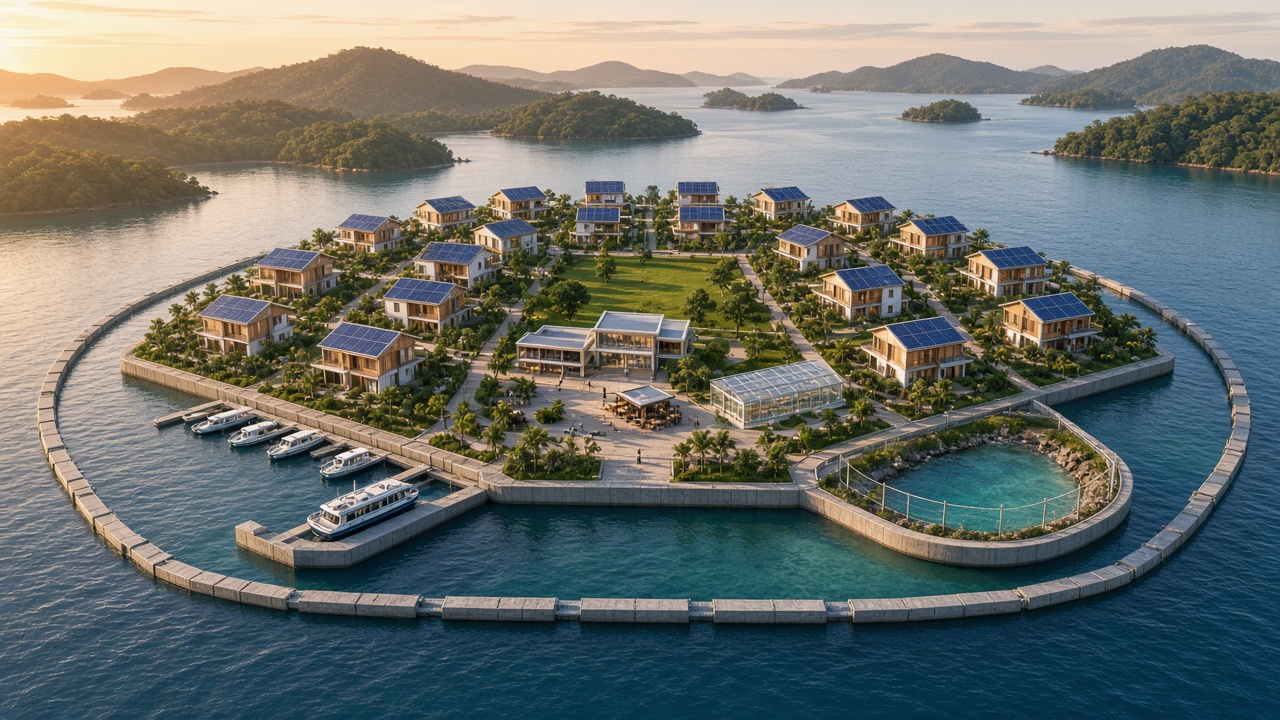 AI-generated impression, not a design drawing. The village in a sheltered Panama-style bay: two-storey solar-roofed homes around a central park, a greenhouse, a marina and a netted swimming lagoon, inside a floating wave attenuator. The reference design is a square 150 × 150 m raft of nine 50 × 50 m concrete modules; the image takes some liberties with the outline.
| Element | Recommendation | Source |
|---|---|---|
| Legal form | Ratified host-state agreement; 75 to 99 year water-space concession; special-zone statute devolving civil and commercial law (ADGM-style); narrow stabilisation clause; international arbitration; contractual right to tow away | 01 §7 |
| Internal structure | Foundation owns the hull; households hold long leaseholds or strata lots; residents' covenant with arbitration | 01, 02 |
| Governance | Signed founding charter; assembly of all adults (60% quorum); five-person elected council; professional captain with safety-only emergency powers that lapse after 72 hours; mediation then arbitration in Singapore or London; external ombudsperson and safeguarding officer; founder seats that expire | 02 |
| Site type | Lagoon or sheltered bay, no tropical storm within 300 km in the 1981 to 2025 IBTrACS record, 100-year Hs ≤ 1.5 m, 10 to 60 m depth | 03 §1 |
| Host and site | Panama, Pacific side (combined score 72); UAE (71) and Malaysia, Johor (70) as close alternatives. On engineering alone: Riau Islands (85), Panama (80), North Malé (79) | 06, 03 §1.10 |
| Platform | Nine reinforced-concrete caissons, 50 × 50 × 6 m, in a 150 × 150 m raft; 22,500 m² gross, ~20,000 m² usable; draught ~2.9 m, freeboard ~3.1 m; ~67,000 t; 25 watertight cells per module; semi-rigid demountable connectors | 03 §3 |
| Wave protection and mooring | ~500 m floating attenuator; 12 mooring points (piles or chain) | 03 §3.7 to 3.8 |
| Energy | ~1,670 kWh/day; 800 kWp rooftop and canopy PV; 2.5 MWh LFP in fire-separated enclosures; 2 × 150 kW HVO generators supplying ~0.5% of annual energy for life safety | 04 |
| Water and waste | 3 × 25 m³/day reverse-osmosis trains (N+1), 250 m³ storage (~1 week), rainwater as a supplement, membrane bioreactor wastewater with greywater reuse | 04 |
| Food | ~6% of calories on board (most fresh vegetables); weekly supply boat; 30 to 90 days of stores | 04 |
| People | ~100 residents in 25 families; 18 to 25 resident staff (clinicians, teachers, marine and engineering watch) | 02, 04 |
| Programme | 5 to 5.5 years from site survey to first residents | 03 §5 |
Which host?¶
Chapter 06 scored eight candidates on nine political-economy criteria (70% weight) plus the engineering score from chapter 03 (30%).
| Rank | Candidate | Combined score | Why |
|---|---|---|---|
| 1 | Panama (Pacific side) | 72 | Territorial taxation, US dollar, strongest investment-treaty cover in the field, a special-zone law to copy (Panamá-Pacífico), Pacific coast largely free of indigenous marine tenure |
| 2 | UAE | 71 | Only candidate with a floating-house statute and common-law zones; on a watch list because of the 2026 Gulf shipping attacks and a poor civil-liberties fit |
| 3 | Malaysia (Johor) | 70 | Same calm Singapore Strait waters as Riau, plus the 2025 Johor–Singapore special economic zone; sea-space tenure law still unresearched |
| 4 | Indonesia (Riau) | 59 | Best engineering, but no route to devolved civil law, a non-mortgageable sea-space permit, and coastal-concession rulings against private control |
| 5 | Maldives | 57 | Floating-city precedent and motive, but slow delivery and political swings |
| 6 to 8 | El Salvador, São Tomé and Príncipe, Kiribati | 48 to 54 | Weaker on durability, practicalities or engineering |
The top three are within the method's margin of error; the winner changes if engineering carries more than half the weight (Malaysia) or if deal durability dominates and civil liberties are ignored (UAE). Panama's genuine weakness is that its Supreme Court annulled two legislatively ratified concessions in 26 months, First Quantum's copper mine (2023) and CK Hutchison's canal ports (January 2026), both on procedural grounds.4 The lesson changes the legal recommendation from chapter 01: in Panama, use a framework statute for a special marine economic area, modelled on Law 41 of 2004 (Panamá-Pacífico), with an autonomous agency, 75 to 99 year tenure and a competitive award, rather than a one-off ratified contract. Panama's planned 2027 to 2029 constitutional rewrite argues for starting with a pilot module under ordinary law (vessel registration plus a 20-year seabed concession).
Reconciled cost¶
Chapters 03, 04 and 05 priced the project independently. They agreed on everything except wave protection: chapter 05 assumed ~600 m of heavier breakwater at ~US$40,000/m (US$24m), whereas chapter 03 sized a floating attenuator for a sheltered lagoon at ~US$10,000/m (US$5m). For the sheltered-lagoon base case the structural chapter's engineering is the better basis, so it is used below. Systems use chapter 04's itemised table, including its integration allowance, instead of chapter 05's lump sums. Fee and contingency rates follow chapter 05.
| US$m, 2026 | Low | Central | High |
|---|---|---|---|
| Marine works: caissons, connectors, tow and installation, attenuator, moorings (03 §7) | 28.3 | 66.0 | 128.8 |
| Houses (6,250 m²) and communal buildings (~2,000 m²) (05 §3) | 15.3 | 22.3 | 32.8 |
| Landscape, greenhouse shell, public realm, marina pontoons (05 §3) | 2.8 | 5.6 | 10.0 |
| Systems incl. integration: energy, water, waste, connectivity, vessels, helideck, safety, clinic (04) | 7.3 | 14.6 | 26.1 |
| Direct cost | 53.7 | 108.5 | 197.7 |
| Design, engineering, class, permits (10 / 12.5 / 15% of non-systems items) | 4.6 | 11.7 | 25.7 |
| Owner's costs, construction insurance, interest (3 / 5 / 8%) | 1.6 | 5.4 | 15.8 |
| Contingency, first-of-a-kind (25 / 32.5 / 40%) | 15.0 | 40.8 | 95.7 |
| Total CAPEX | 75 | 166 | 335 |
| Per family (25) | US$3.0m | US$6.7m | US$13.4m |
| Per m² of usable deck | US$3,750 | US$8,300 | US$16,700 |
Risk-adjusted. Applying chapter 05's reference-class scenarios (35% disciplined at ×1.15, 40% typical overrun at ×1.5, 25% fat tail at ×3.0) to the pre-contingency base of US$126m gives an expected outturn of about US$220m, or US$8.8m per family. For comparison, Oceanix Busan's budget roughly tripled from about US$200m to about US$600m before any construction began.12
Running cost. Chapter 05's OPEX of about US$6.5m a year stands after reconciliation: the larger staff in chapter 04 (+US$0.4m) is roughly offset by lower maintenance and insurance on the smaller marine-works figure. That is about US$21,000 per family per month gross, or about US$19,000 after community revenue (guest rooms, marina, research berths). Insurance (~US$1.5m) and staff (~US$1.7m including teachers) dominate; energy is trivial.
What the premium buys. A comparable village on land in Panama or Portugal costs about US$1.1m to US$1.2m per family (05 §8). The seastead therefore costs roughly six times as much for the same houses and gardens. The extra money buys two things land cannot: devolved self-government under a purpose-written charter, and the option, expensive but real, to tow the town to another host.
What the design basis got wrong¶
The researchers challenged the starting assumptions. These revisions are adopted for any next iteration:
- "Country" becomes "autonomous community under a host charter". Calling it a country invites the fate of Minerva and the Thai seapod.
- The exposed-EEZ and high-seas archetypes are dropped for Phase 1. The EEZ gives the host the same exclusive jurisdiction as the territorial sea (UNCLOS Art. 60(2)) at three to five times the cost, and puts US citizens outside the foreign earned income exclusion. The high seas are deeper than any mooring yet installed and offer no insurance, no lender and no legal protection.
- The cyclone rule changes from "within ±5 to 8° of the equator" to "no storm of 34 kt or more within 300 km in the IBTrACS record". Funafuti at 8.5°S is cyclone country; Panama at 8.6°N is not.
- Energy demand is 1.7 MWh/day, not 1 MWh. Air-conditioning dominates. Solar remains under 3% of CAPEX, so this is not a cost problem.
- "Fully solar" becomes "≥ 97% solar in any year, with a renewable-fuel safety net". Class-society logic, battery-fire risk and every remote microgrid precedent (Tokelau, Ta'u) keep a generator.
- Staff are 18 to 25, not 10 to 15. A 24-hour clinic, a school and marine watchkeeping need the people.
- Concession length must exceed design life. A 50-year hull on a 20-year renewable lease is a stranded asset. Specify the hull for 100 years (about 10 mm more concrete cover) and seek a 75 to 99 year concession.
- Add a deck-load budget (~0.6 t/m² average topsides). Soil gardens are heavy; use containers and hydroponics.
- Consider 14,000 m² instead of 20,000 m². Chapter 05 shows this saves about US$30m (16%) while keeping generous outdoor space. Keep 20,000 m² as an option.
- Births happen ashore, and secondary schooling needs a plan before anyone moves. Families with teenagers are the first to leave.
- Write the charter for Phase 2 (~330 people) from day one.
The five risks that decide it¶
| # | Risk | Why it matters | Mitigation |
|---|---|---|---|
| 1 | Host-state reversal | Próspera's legal basis was struck down by Honduras's Supreme Court; its investors' claim has since been cut from US$10.8bn to US$1.63bn and remains unresolved.3 French Polynesia dropped its 2017 MoU in an election campaign. | A framework statute with competitive award rather than a one-off ratified contract (Panama annulled two of those in 26 months); local benefit-sharing and jobs; consult before naming a site; tow-away right; don't call it a country |
| 2 | Uninsurable and unbankable | MV Satoshi was scrapped largely because it could not get insurance; SeaPods get only third-party liability cover. | Class the platform as a floating installation; get written insurance quotes as a Stage 0 gate |
| 3 | Fat-tailed cost overrun | Every floating-city estimate with a revision history has risen 2 to 3 times. | Pilot module first; founders' standby capital; pre-agreed stop or de-scope rule |
| 4 | Short-period waves and connector fatigue | The binding design case is everyday lagoon chop, not the 100-year storm; multi-module residential rafts have little precedent. | 12 months of wave-buoy data and model-basin tests before detailed design |
| 5 | Social attrition | With 25 payers, every departing family raises everyone else's levy, and there is no resale market yet. | Strict entry vetting, a school plan, a buy-back fund, and a charter that allows orderly exit |
Staged plan¶
| Stage | Scope | Indicative cost | Gate to proceed |
|---|---|---|---|
| 0. Studies (12 to 18 months) | Host negotiation to term sheet, site met-ocean campaign, basin tests, class pre-approval, insurance quotes, draft charter | US$2m to US$4m | Binding host term sheet; written hull and liability quotes; P80 estimate within founders' committed capital |
| 1. Pilot (about 24 months) | One 50 × 50 m module, 2 to 3 homes, utility core, 150 m attenuator, one vessel | US$15m to US$25m | Survives a full wet season within motion criteria; measured maintenance cost; insurance renewed; one mortgage offer obtained |
| 2. Phase 1a | 4 to 5 modules, 12 homes, communal core | ~45% of Phase 1 | Outturn within +25% of the Stage 1 estimate |
| 3. Phase 1b | Complete the village, 25 homes | Balance | As above |
The pilot costs about a tenth of the full village. Its job is to answer the questions that killed earlier projects (is it insurable, bankable, legally stable and comfortable?) before most of the money is spent.
Who this is for, and the cheaper village¶
The reference design describes a group of 25 households each able to commit about US$7m of equity plus US$2m of standby capital (so a net worth in the region of US$20m to US$40m each) and willing to wait six years. That is not the broad libertarian membership the seasteading movement originally imagined.
Chapter 07 tests how far that can be pushed down without losing the brief. Its recommended Village 40 puts 40 families in terraced timber townhouses (120 to 160 m², each with a 40 m² garden or terrace) on six of the same 50 × 50 m caissons, giving 13,300 m² (3.3 acres) of usable deck. Public open space falls from about 50 m² to 27.5 m² per resident, still about 1.4 times the UK minimum park standard.
| Reference (25 homes, 20,000 m²) | Village 40 (40 homes, 13,300 m²) | |
|---|---|---|
| CAPEX, central (low to high) | US$166m (75 to 335) | US$114m (58 to 233) |
| Per family, central | US$6.7m | US$2.9m |
| Per family, risk-adjusted | US$8.8m | US$3.8m |
| Running cost per family per month, net of community revenue | ~US$19,000 | ~US$10,300 |
| Multiple of an equivalent land village in Panama | ~6× | ~4.5× |
| Implied founder net worth | US$20m to US$40m | US$8m to US$17m |
About half of the saving comes from spreading fixed costs (breakwater, moorings, staff, insurance) over more families and half from genuine cuts, mainly the smaller platform. Scale helps but flattens quickly: per-family CAPEX is US$2.5m at 60 families and US$2.4m at 75. The trade-offs are real. Roofs now supply only about 69% of the solar capacity needed, so about 1,600 m² of PV canopies over paths and the plaza are required to stay ≥ 97% solar. The village also leans on the host city for its ferry, hospital and secondary schools, which is cheaper but gives the host more leverage.
One tension between the two new chapters matters: about US$9m of Village 40's saving assumes casting the hull in a low-cost yard next to the site, which is easy near Batam (Riau) but not in Panama. At a Panama site Village 40 costs about US$3.1m per family (US$4.1m risk-adjusted). The politically preferred host is therefore slightly more expensive than the engineering favourite.
Reaching households with only US$1m to US$2m to commit needs a stretch case: 75 families, the host paying for the breakwater and moorings, and mortgages on the houses. That makes the host partnership, perhaps framed as a climate-adaptation demonstrator, the real key to accessibility.
Open questions for the next iteration¶
- Malaysia's sea-space tenure law. The one unresearched input that could reorder the top three hosts.
- Panama yard options. Whether a casting basin on Panama's Pacific coast (or a tow from Asia) can recover Village 40's yard saving.
- Insurance market test. Approach two or three marine underwriters with the reference design.
- Exit value. What is a floating home in a chartered zone worth on resale, and who buys?
- Exposed-site Phase 2. Only worth revisiting if the pilot succeeds and the host relationship is stable.
References¶
Detailed references for every claim are in the domain chapters (01: 76, 02: 83, 03: 108, 04: 99, 05: 83, 06: 99, 07: 47). The footnotes below cover facts re-checked independently for this synthesis.
-
Business Insider, "UN backing a floating city in South Korea that can withstand floods", November 2021 (US$200m estimate). https://www.businessinsider.com/floating-city-united-nations-south-korea-2021-11 (accessed 4 Nov 2026). ↩
-
Busan Ilbo, "북항 2단계서 물밑 추진… 자금 조달 확정 땐 수면 위로" (US$600m budget, funding unconfirmed), 4 August 2025. https://www.busan.com/view/busan/view.php?code=2025080418191453209 (accessed 4 Nov 2026). ↩
-
Procuraduría General de la República (Honduras), "Próspera baja su reclamo de $10,775 millones a $1,630 millones tras casi dos años de litigio en el CIADI", 22 October 2025. https://pgr.gob.hn/2025/10/22/prospera-baja-su-reclamo-de-10775-millones-a-1630-millones-tras-casi-dos-anos-de-litigio-en-el-ciadi/ (accessed 4 Nov 2026). See also ICSID Case No. ARB/23/2: https://icsid.worldbank.org/cases/case-database/case-detail?CaseNo=ARB%2F23%2F2 ↩
-
Corte Suprema de Justicia de Panamá, "Comunicado del Pleno", 29 January 2026 (Law 5 of 1997 and the Panama Ports Company concession declared unconstitutional). https://www.organojudicial.gob.pa/uploads/blogs.dir/1/2026/01/426/comunicado-pleno-de-la-csj-29-de-enero-de-2026-1.pdf (accessed 4 Nov 2026). See also Reuters, "Panama court quashes CK Hutchison port contracts, clouding sales plan", 30 January 2026: https://www.reuters.com/world/asia-pacific/panama-court-voids-ck-hutchison-port-contracts-2026-01-30/ ↩